Walk into the heart of Connaught Place in New Delhi and you will stumble upon something that looks almost otherworldly: towering pink-and-cream stone structures, curved staircases leading skyward, and giant sundials that seem to defy explanation. This is Jantar Mantar Delhi, one of the most fascinating monuments in India, a place where science, art, and a deep devotion to the sky come together in stone.
Long before telescopes and satellites existed, Indian astronomers used these very instruments to track planets, predict eclipses, and measure time with astonishing accuracy. For travelers piecing together an itinerary through North India, Jantar Mantar is more than a quick photo stop; it is a genuine window into how ancient India understood the cosmos. And because Delhi is almost always the starting point of a classic Golden Triangle Tour, this observatory naturally becomes one of the very first stories your trip has to tell.
What Is Jantar Mantar, Exactly?
In simple terms, Jantar Mantar is an open-air astronomical observatory made up of large-scale masonry instruments. Unlike telescopes, these structures rely on geometry, shadow, and scale rather than lenses. Each one was built to answer a specific question: what time is it, where is the sun right now, how high is a particular star, or when will the next eclipse occur. The name itself comes from yantra (instrument) and mantra (formula or calculation), meaning, quite literally, a “calculating instrument.”
The History and Visionary Behind Jantar Mantar
Jantar Mantar Delhi was commissioned in 1724 by Maharaja Sawai Jai Singh II, the ruler of Jaipur and a passionate scholar of astronomy and mathematics. Jai Singh was troubled by the inaccuracy of the small brass astronomical instruments used in his time. Existing tables and calculations, borrowed largely from Islamic and European traditions, often produced errors when predicting planetary positions or eclipses.
His solution was bold: build instruments so large that even tiny measurement errors would become statistically insignificant. Larger scale meant sharper shadows, finer gradations, and far greater precision. Delhi’s Jantar Mantar was the first of five such observatories Jai Singh built across India, the others being in Jaipur, Ujjain, Mathura, and Varanasi. Of these, the Jaipur and Delhi observatories remain the best preserved and most visited today.
What makes Jai Singh’s project remarkable is that it blended Hindu, Islamic, and European astronomical knowledge into a single, uniquely Indian system. He sent scholars to study foreign observatories and cross-checked his instruments against their recorded data, refining designs until the readings matched observed celestial events. In many ways, Jantar Mantar was less a monument and more a working scientific laboratory, one that happened to also be a masterpiece of architecture.
Architectural Marvels: Breaking Down the Instruments
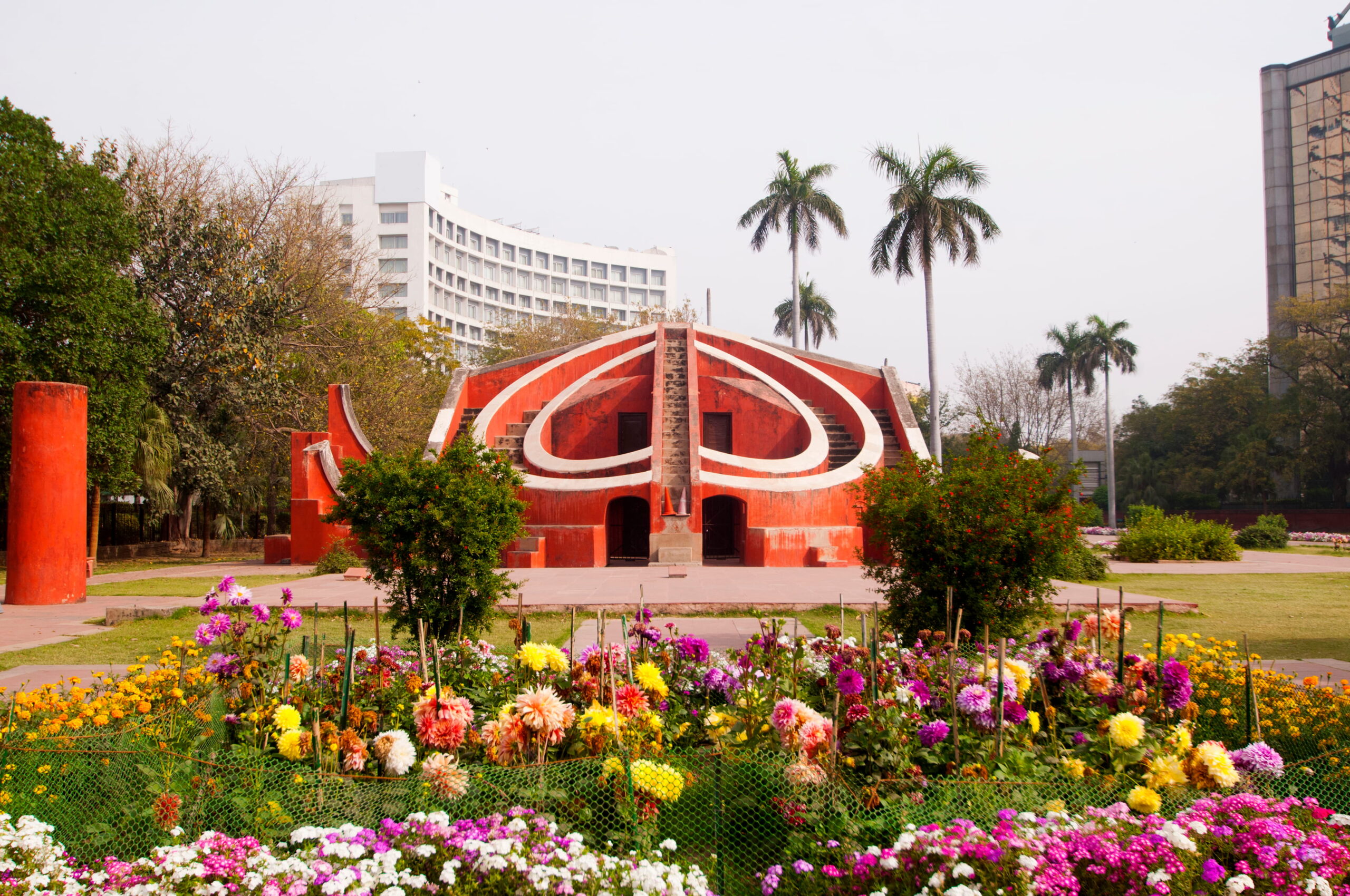
Delhi’s Jantar Mantar houses several instruments, each with a distinct purpose. Here is what to look for and why it matters:
Samrat Yantra (The Supreme Instrument)
- What it is: A giant triangular sundial, and the centerpiece of the entire complex.
- How it works: Its hypotenuse runs parallel to the Earth’s axis, pointing directly at the North Pole. As the sun moves, the shadow cast by this triangle sweeps across two curved quadrants on either side.
- Why it matters: It can tell local time accurate to roughly 20 seconds, an extraordinary feat for an instrument built entirely from stone and mortar three centuries ago.
Jai Prakash Yantra (The Hemispherical Bowl)
- What it is: A pair of concave, bowl-shaped structures set into the ground, marked with an intricate grid of lines.
- How it works: A metal ring suspended above the bowl casts a shadow onto the marked surface, mapping the exact position of the sun or any visible celestial object at a given moment.
- Why it matters: It effectively projects the entire sky onto a physical surface, allowing astronomers to pinpoint coordinates such as altitude and azimuth with remarkable ease.
Misra Yantra (The Mixed Instrument)
- What it is: A composite structure combining five different sub-instruments in one design, believed to be a later addition, possibly influenced by European visitors.
- How it works: It can determine the shortest and longest days of the year, calculate the moment of local noon, and even reveal simultaneous noon times in several cities around the world.
- Why it matters: It shows how Jai Singh’s team continued to experiment and innovate, layering new functions onto the original observatory long after its initial construction.
Ram Yantra and Digamsha Yantra
- Ram Yantra: A pair of cylindrical structures used to measure the altitude and azimuth of the sun and stars, essentially an early coordinate-tracking system.
- Digamsha Yantra: A tall pillar surrounded by circular walls, used to determine the azimuth of the sun and to track sunrise and sunset positions through the seasons.
Together, these structures form a working demonstration of how mathematics, architecture, and observation converged in eighteenth-century India, long before modern instrumentation existed.
Fitting Jantar Mantar Into Your India Itinerary
Because Jantar Mantar sits centrally in New Delhi, close to Connaught Place, India Gate, and the diplomatic enclave, it slots effortlessly into a half-day city tour. Most travelers pair it with nearby landmarks such as the Agrasen ki Baoli stepwell or the shopping lanes of Janpath, making it easy to combine heritage sightseeing with a bit of leisure in a single morning.
For international visitors, though, Delhi is rarely the whole story. It is typically day one of a much bigger adventure. A classic Golden Triangle Tour links Delhi with Agra and Jaipur, tracing a route that moves from Mughal-era astronomy and architecture in the capital, to the timeless romance of the Taj Mahal, and finally to the pink-hued forts and bazaars of Rajasthan. Since Jai Singh II built a twin observatory in Jaipur, seeing Delhi’s Jantar Mantar first gives travelers a satisfying sense of continuity when they reach its sister site a few days later.
Travelers with more time, or a deeper interest in nature and wildlife, often extend this classic loop into a Golden Triangle with Ranthambore Tiger Safari. After exploring Jaipur, the route swings toward Ranthambore National Park, one of India’s most celebrated tiger reserves, before looping back or continuing onward. This extended circuit is especially popular with heritage travelers who also want a genuine wildlife encounter, since it combines centuries-old monuments with the thrill of spotting a tiger in the wild.
If wildlife is part of your plan, it helps to travel with people who know the terrain. Specialists who run guided Ranthambore photography experiences can help you time your safari drives around the golden light of early morning and late afternoon, exactly when tigers are most active and the park’s photography conditions are at their best. Pairing a few days of history in Delhi and Jaipur with a couple of safari drives in Ranthambore gives you a rounded picture of India: its past carved in stone, and its wilderness very much alive.
Curious how the same expertise applies across India’s other reserves? A quick look at the Ranthambore wildlife photography tour page shows how safari timing, lighting, and guide experience come together to make the wildlife leg of your Golden Triangle journey just as memorable as the monuments.
Practical Travel Tips for Visiting Jantar Mantar
Best Time to Visit
- Season: October through March is ideal, when Delhi’s weather is cool and comfortable for walking around an open-air site.
- Time of day: Early morning, shortly after opening, offers soft light and thinner crowds. Late afternoon is a close second, especially for photography.
- Avoid: The peak summer months of May and June, when the stone structures absorb intense heat with almost no shade available.
Photography Tips
- Shoot the Samrat Yantra from a low angle in the early morning to capture dramatic shadows across the quadrants.
- Use the curved lines of the Jai Prakash Yantra to create leading lines toward your main subject.
- Midday light tends to flatten the stonework, so plan your visit around the golden hours if photography is a priority.
- A wide-angle lens works well for the Misra Yantra, since it captures the layered geometry of its multiple sub-instruments in a single frame. If you want to sharpen these skills before your safari days in Ranthambore, it helps to learn from an experienced wildlife and travel photographer who understands how light behaves in both heritage sites and the wild.
Nearby Attractions
- Connaught Place, for shopping, cafes, and colonial-era architecture just a short walk away.
- Agrasen ki Baoli, a striking stepwell hidden between modern office blocks.
- India Gate and the Rajpath, roughly a 15-20 minute drive, ideal for an evening stroll.
- Humayun’s Tomb, a UNESCO World Heritage Site that pairs beautifully with a heritage-focused day in Delhi.
Entry to Jantar Mantar is ticketed, with separate rates for domestic and international visitors, and the site is typically open daily from sunrise to sunset. It is worth budgeting 45 minutes to an hour to properly explore each instrument rather than rushing through.
A Lasting Tribute to India’s Scientific Heritage
Jantar Mantar Delhi is proof that curiosity and ambition can outlast centuries. Long before modern science arrived in India, Maharaja Jai Singh II built instruments of stone that measured the heavens with genuine precision, a scientific triumph disguised as architecture. Standing among these silent, sun-drenched structures today, it is hard not to feel a quiet sense of wonder at how much the human mind can achieve with nothing more than geometry, patience, and a deep desire to understand the sky.
For travelers, it is also the perfect opening chapter to a much larger story. Whether your journey continues through the palaces of Jaipur and the marble domes of Agra, or extends further into the wild heart of Ranthambore, Jantar Mantar sets the tone: India’s past is not something behind glass in a museum. It is something you can walk through, touch, and, for a moment, use to tell the time exactly as it was told three hundred years ago. If you are still shaping your route, it is worth reaching out to plan your Golden Triangle and wildlife itinerary with specialists who know both the monuments and the wilderness that follows.

Yogesh Bhatia is a professional Wildlife photographer & mentor in India whose work reflects patience, observation, and a deep respect for nature. His journey in wildlife photography is shaped by countless hours in forests, observing animal behavior and waiting for moments that unfold naturally. Through his lens, wildlife is portrayed not just as subjects, but as living stories within their natural environment. His approach to Wildlife photography India focuses on authenticity rather than staged perfection, resulting in images that feel raw and immersive.