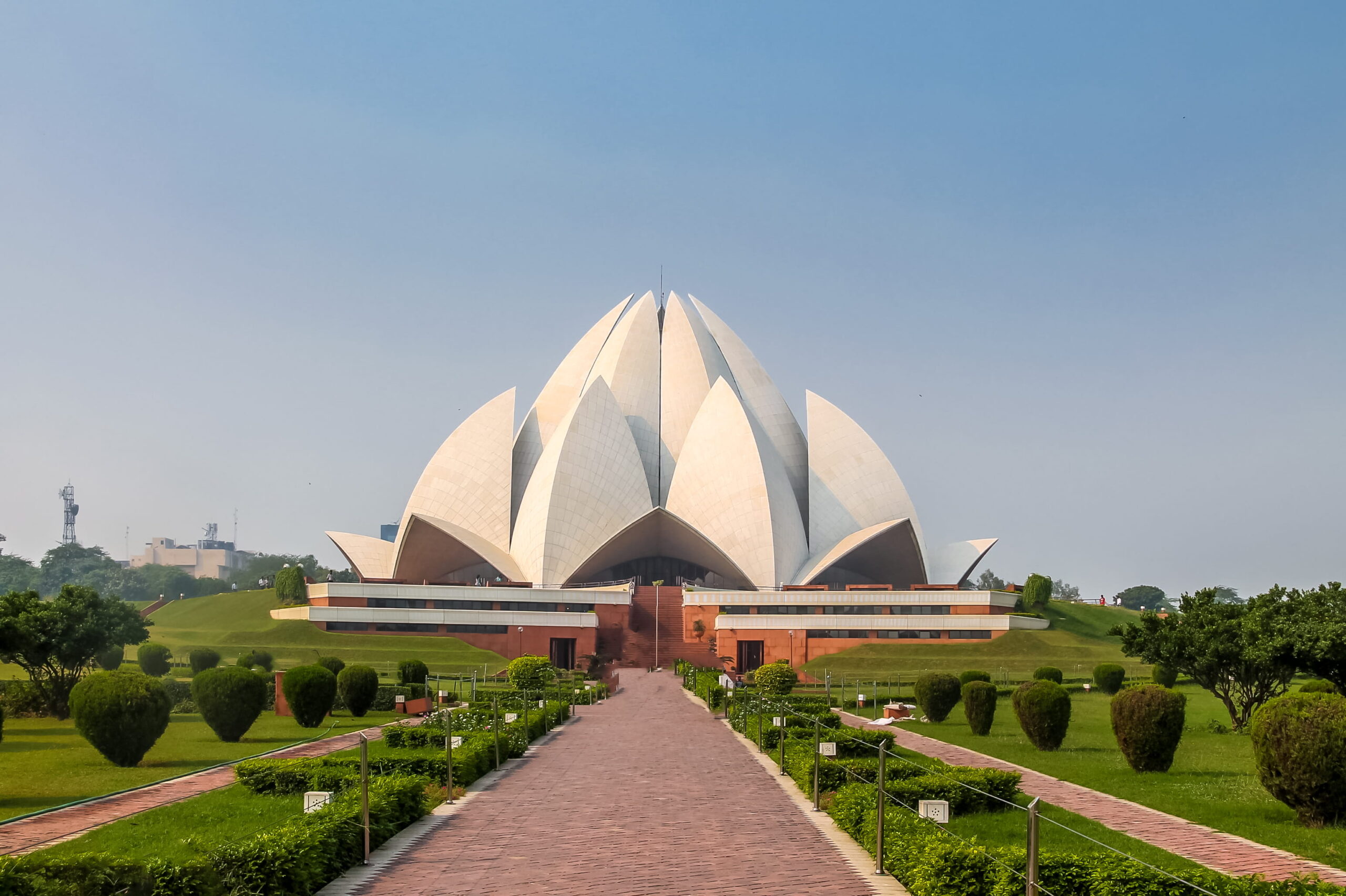
There’s a moment every visitor to Delhi remembers: rounding a bend in Nehru Place and seeing 27 marble petals rising out of the ground like they’ve just bloomed. That’s the Lotus Temple, officially the Bahá’í House of Worship, and it’s one of the few modern buildings in India that stops tourists mid-step. No dome, no minaret, no centuries-old stone carving, just pure, sculptural calm.
If you’re building an itinerary around Delhi, Agra, and Jaipur, this temple deserves a slot on day one. It’s quiet, it’s free, and it sets an unusual tone before you dive into Mughal forts and pink-city bazaars. In fact, most travelers doing a classic Golden Triangle Tour start their Delhi leg here, precisely because it’s calm, uncrowded in the morning, and a refreshing contrast to the grandeur that follows at Agra and Jaipur.
The Architectural Marvel: 27 Petals, One Vision
The Lotus Temple was designed by Iranian-American architect Fariborz Sahba and completed in 1986. What looks like a single flower is actually a precise feat of structural engineering, built almost entirely from white marble sourced from Penteli, Greece, the same quarries used for the Acropolis.
Understanding the Petal Structure
The building is made of 27 free-standing marble “petals,” arranged in three clusters of nine:
- Nine petals curve inward to form the entrance.
- Nine petals curve outward, welcoming visitors from every direction.
- Nine petals sit at the center, folding upward to form the roof of the main hall.
This nine-fold symmetry isn’t decorative, it’s a deliberate nod to the Bahá’í belief that nine represents unity and completeness. Structurally, each petal is a self-supporting shell, meaning the entire dome-like form holds together without a single interior pillar. It’s the same principle used in the Sydney Opera House, adapted here into an organic, flower-like silhouette.
Engineering Made Simple
You don’t need an engineering degree to appreciate the math. Picture the temple sitting inside a circle, with the petals unfurling like a flower opening at sunrise. The nine entrances open onto nine reflecting pools, so the entire structure appears to float on water when viewed from above. The building can hold up to 2,500 people at once, yet from the outside it reads as delicate as an actual flower petal, that contrast between scale and lightness is the real achievement here.
Spiritual Symbolism: Why a Lotus?
The Lotus Temple belongs to the Bahá’í Faith, a relatively young religion founded in 19th-century Persia that teaches the essential worth of all religions and the unity of humankind. Its core message is simple: there is one God, one human family, and every major faith is a chapter in the same unfolding story.
The lotus flower was chosen deliberately. Across Hinduism, Buddhism, Islam, and Jainism, the lotus already carries meaning, purity, peace, and rebirth, growing clean out of muddy water. By building a house of worship shaped like a flower every Indian tradition already recognizes, the design speaks a shared visual language before a single word is said.
A Temple Open to Everyone
This is what genuinely surprises first-time visitors: there are no idols, no rituals, no sermons. Anyone, Hindu, Muslim, Christian, Sikh, atheist, or otherwise, is welcome to sit inside and pray, meditate, or simply sit in silence, in whatever way feels natural to them. That openness is the entire point of Bahá’í worship spaces around the world, and it’s what makes the Lotus Temple feel less like a religious site and more like a shared human one.
The Visitor Experience: What Happens Inside
You’ll queue outside, leave your shoes at the counter, and walk up a gentle ramp toward the main hall. The moment you step through the petals, the atmosphere changes completely.
- Absolute silence is enforced inside the prayer hall, no talking, no phone calls, no whispered narration for the camera.
- The main hall seats visitors on simple wooden benches facing no particular direction, reflecting the temple’s non-denominational nature.
- Sunlight filters through the petal structure, changing the mood of the hall through the day.
- Outside, manicured gardens and the nine reflecting pools give you space to walk, sit, and take in the structure from different angles.
Most people spend 45 minutes to an hour here, 10 to 15 minutes inside the hall and the rest wandering the gardens and pools. It’s less a monument you “see” and more one you sit with for a while.
Crucial Visitor Tips for the Lotus Temple
Timings and Entry
- Entry is completely free.
- Open Tuesday to Sunday, 9:00 AM to 5:30 PM (closed on Mondays); timings shift slightly by season, so it’s worth a quick online check before you go.
- Arrive by 8:30–9:00 AM to beat both the heat and the tour-bus crowds.
Dress Code and Etiquette
- There’s no strict dress code, but modest clothing (covering shoulders and knees) is respectful, especially inside the prayer hall.
- Shoes come off before the ramp, wear socks in summer, since the marble gets hot underfoot.
- Silence is mandatory inside the hall; save your questions and reactions for outside.
Photography Rules
- Photography is allowed in the gardens and around the pools, but not inside the prayer hall.
- Tripods and professional camera setups may need prior permission, a basic phone or camera is fine for casual shots.
Getting There by Metro
- The nearest station is Kalkaji Mandir on the Violet and Magenta Lines, about a 10-minute walk from the entrance.
- Delhi Metro is by far the easiest way in, traffic around Nehru Place can be heavy, especially on weekends.
Best Time to Visit
- October to March offers the most pleasant weather for the walk-up and garden time.
- Early mornings on weekdays are the quietest; weekends and public holidays draw large domestic crowds.
- If you’re combining it with other South Delhi sights, pair it with a half-day covering ISKCON Temple and Nehru Place market.
Beyond Delhi: The Perfect Golden Triangle Itinerary
The Lotus Temple works beautifully as a gentle, reflective start to a much bigger journey. Once you’ve soaked in Delhi’s mix of Mughal history and modern architecture, the Red Fort, Humayun’s Tomb, Qutub Minar, and the Lotus Temple itself, the natural next stop on a Golden Triangle Tour is Agra, home to the Taj Mahal, followed by Jaipur’s forts and bazaars.
But if you have a few extra days, consider extending the loop into Ranthambore National Park. A Golden Triangle with Ranthambore Tiger Safari itinerary typically looks like this:
- Delhi (2 days): Lotus Temple, Red Fort, Humayun’s Tomb, Qutub Minar, Chandni Chowk.
- Agra (1–2 days): Taj Mahal at sunrise, Agra Fort, Mehtab Bagh.
- Ranthambore (2 days): Two to three jungle safaris tracking the park’s famous tigers, plus Ranthambore Fort.
- Jaipur (2 days): Amber Fort, City Palace, Hawa Mahal, and the local bazaars.
This combination gives you heritage, spirituality, and wildlife in a single, well-paced loop, history in the mornings, wilderness in the evenings. For travelers who want the safari portion led by someone who genuinely knows the terrain and animal behavior, it’s worth arranging your Ranthambore leg through a specialist rather than a generic add-on.
Yogesh Bhatia’s Ranthambore photography workshop is built exactly for this, small groups, experienced field guidance, and safaris timed for the best tiger sightings, making it a natural fit for the wildlife leg of a Golden Triangle with Ranthambore Tiger Safari itinerary.
If tigers aren’t the only wildlife on your radar, it’s worth browsing the full range of wildlife photography tours across India, covering everything from Kanha to Corbett to Kaziranga, in case you want to extend your trip beyond the classic circuit.
To get a sense of the person leading these expeditions and how the trips are actually run, the About Us page is a good starting point before you plan the safari dates around your Delhi–Agra–Jaipur schedule.
For more India travel planning, from temple architecture to national park guides, the travel and wildlife blog has itinerary breakdowns worth reading before you lock in your dates.
And once you’re ready to build out the Ranthambore dates around your Golden Triangle stops, the Contact Us page is the quickest way to check availability and get a tailored plan.
Conclusion: A Soul-Stirring Start to Your Indian Adventure
The Lotus Temple isn’t trying to compete with the Taj Mahal or the forts of Rajasthan, and that’s exactly its appeal. It offers something those grand, ornate monuments don’t: total stillness. Standing among those 27 marble petals, surrounded by people of every faith sitting in shared silence, you get a rare, unfiltered sense of what India’s diversity actually feels like in practice.
Whether you’re spending 48 hours in Delhi or building out a full two-week Golden Triangle Tour with a tiger safari in Ranthambore, start here. It costs nothing, takes under an hour, and quietly resets the tone for everything that follows, palaces, forts, and jungles included.

Yogesh Bhatia is a professional Wildlife photographer & mentor in India whose work reflects patience, observation, and a deep respect for nature. His journey in wildlife photography is shaped by countless hours in forests, observing animal behavior and waiting for moments that unfold naturally. Through his lens, wildlife is portrayed not just as subjects, but as living stories within their natural environment. His approach to Wildlife photography India focuses on authenticity rather than staged perfection, resulting in images that feel raw and immersive.